Problems We Fix · Ponte Vedra Beach
Sub-Zero EC 50, EC 40 & Vacuum Condenser Codes in Ponte Vedra Beach
EC warnings tell us the unit worked too hard. They do not name the part. In Ponte Vedra Beach, the first suspects are salt-loaded airflow, weak fan movement, and door leakage before sealed-system work enters the conversation.
EC 50 points us to the refrigerator side; EC 40 points us to the freezer side. The older 600 series often says “Vacuum Condenser” instead of giving a number. In 32082, we start with coil condition, fan output, gasket seal, and sensor data because salt air and tight cabinetry cause many excessive-run warnings. Sealed-system testing comes after those checks, not before them.
For Sub-Zero repair across Ponte Vedra Beach — Sawgrass, Marsh Landing and the oceanfront — call (904) 902-0927 or Book online.
Sub-Zero Repair Ponte Vedra reads these warnings across the 32082 ZIP with a diagnosis-first house call: the line at (904) 902-0927 answers Monday through Saturday, and the external booking page takes appointments at any hour.
The Codes, Defined
What Each Real Sub-Zero Code Is Telling You
Sub-Zero does not use an endless hidden code list for this problem. These warnings are about run time, side of cabinet, and board generation. The display starts the visit; it does not finish the diagnosis.
- EC 50
- Fresh-food side ran longer than expected. On coastal installs, that usually sends us to the condenser intake, grille clearance, gasket seal, and fan output first.
- EC 40
- Freezer side ran longer than expected. On a dual-system PRO 48, this side-specific flag keeps the refrigerator half out of the repair path.
- “Vacuum Condenser” light
- Older 600 series wording. It is the board's plain-English way of asking for condenser and airflow attention before run time does damage.
- Service light flashing
- A broad attention flag. Stored history and meter readings decide whether it belongs with an excessive-run event, a sensor, or another board input.
Read them all as invitations to test. The board knows the timeline; the visit has to prove the cause.
Cause, Evidence, Cost
What Sits Behind an Excessive-Run Code
This is the order we use because it matches the coast. Salt and dust load the coil, millwork limits breathing room, and old gaskets leak humid air. Refrigerant work comes after those facts are cleared.
| Likely cause | Evidence at the unit | Cost lane |
|---|---|---|
| Salt-loaded condenser intake | White grit on fins, warm kickplate, weak pull through grille | $250–$550 |
| Fan or board-output fault | Fan command present but movement low, or board output missing | $550–$1,100 |
| Coastal-hardened gasket | Loose paper test, warped magnet strip, moisture at the seal line | $550–$1,100 |
| Incorrect temperature input | Thermistor reading does not match the measured cabinet temperature | $550–$1,100 |
| Refrigerant leak or restriction | Clean air path, but the evaporator frosts only near the inlet | $1,500–$3,000 |
When the evidence moves past airflow and electronics, the work becomes refrigeration: leak confirmation, recovery, brazing, evacuation, and a weighed charge. That practice has its own page, because it is the center of what we do.
One line, one technician, no dispatch queue
(904) 902-0927Cheapest Cause First
The Diagnostic Sequence for an EC Code
The order is boring by design. It keeps a maintenance warning from turning into an unnecessary sealed-system quote.
- Pull stored history. Frequency and timing tell us whether the warning built slowly, followed a storm, or appeared after a door-seal change.
- Open the air path. Coil face, grille clearance, fan blade, and any custom panel work that narrows the intake.
- Check the door load. Paper test, hinge alignment, magnet strip, and any moisture trail where humid air is entering.
- Meter the inputs and outputs. Fan amperage, board command, and thermistor resistance against a known cabinet temperature.
- Expose the evaporator only after the basics pass. A complete frost face points away from refrigerant loss; a short inlet patch changes the work order.
- Write the finding down. The owner sees cause, evidence, and approved number before the repair moves forward.
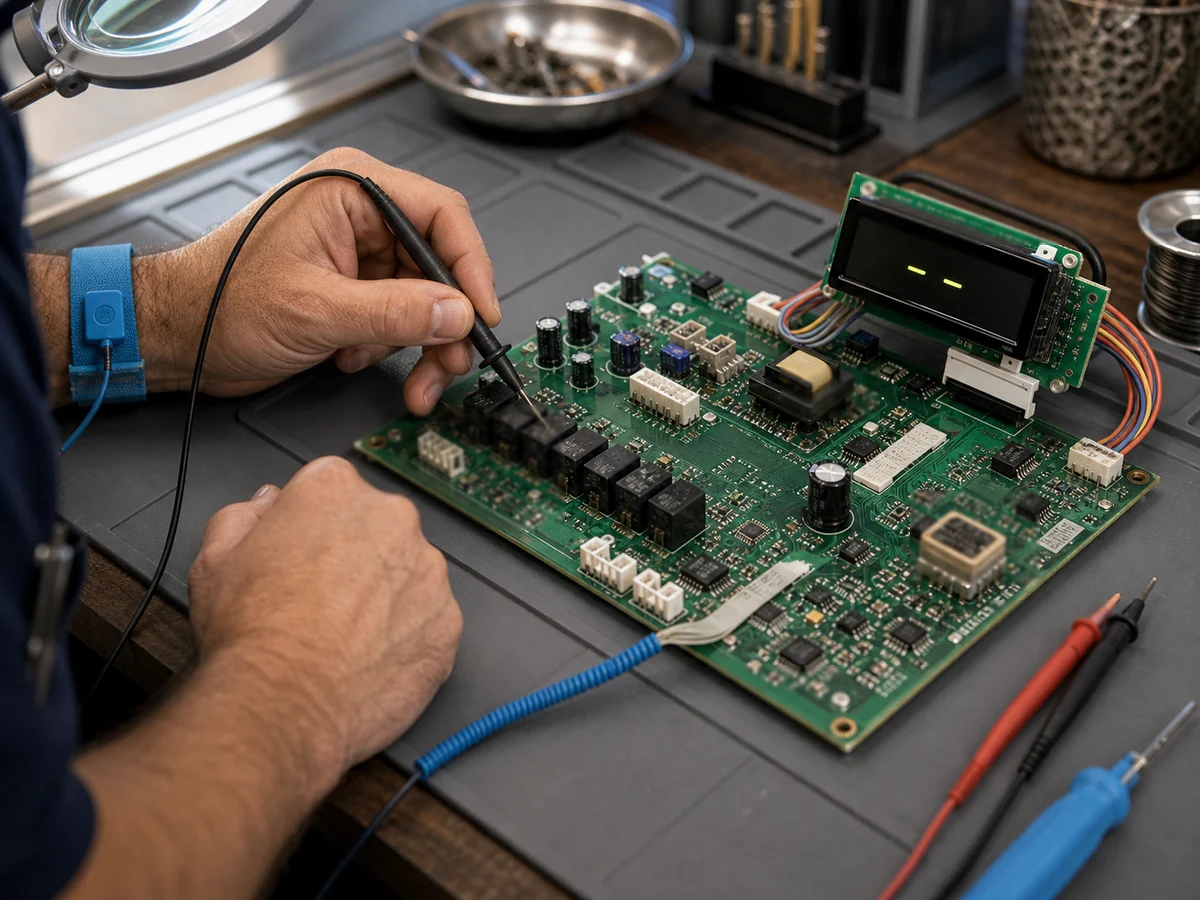
EC 50 vs EC 40
Why the Side Matters on a PRO 48
On most 500- and 600-series classics still on duty in Old Ponte Vedra and early Marsh Landing kitchens, one compressor and one sealed circuit serve the whole cabinet, so EC 50 and EC 40 point at the same hardware. The PRO 48 is the exception that makes the distinction worth knowing. It runs two fully independent systems — a dedicated compressor and sealed circuit for each side — so an EC 40 logging on the freezer side alone isolates the fault to one half of the unit.
That isolation saves money and time. We open and test the flagged side first and leave the working half undisturbed, instead of pulling the whole unit apart on a hunch. On a single-system classic, by contrast, either code sends us to the one shared condenser and the one shared compressor — the same suspects in the same order.
The Two-Thousand-Dollar Fork
Clean-Coil Long Run vs a Real Sealed-System Leak
The expensive fork appears only after the air path is proven clean. At that point we are separating a cabinet still rejecting heat poorly from a refrigeration circuit that cannot move heat correctly.
| Tell | Cleaning-lane cause | Sealed-system cause |
|---|---|---|
| Onset | Slow drift after missed coastal maintenance | Temperature loss that keeps returning after service |
| Evaporator frost | Coil face fills evenly | Frost starts strong, then stops early |
| Condenser | Loaded coil, restricted grille, or weak fan | Clean coil and verified fan movement |
| Response to cleaning | Run time falls back into normal range | Run time stays long after airflow is restored |
| Cost lane | $250–$550 | $1,500–$3,000 |
The frost pattern is physical evidence. A complete frost face says the charge is doing its job. A frost patch that dies early says the circuit needs leak and restriction testing. On a legacy 500- or 600-series cabinet, even sealed-system work usually beats replacement; the 500 series history and the sealed-system line walk that math through.
Local Conditions
Why 32082 Throws These Codes More Than Inland Jacksonville
Two coastal forces drive the excessive-run warnings we see here. Salt is the first. Ocean air leaves chloride on the condenser fins, especially on Ponte Vedra Boulevard and the Sawgrass oceanfront rows. Once the fin pack loses its clean edge, the cabinet runs longer to dump the same heat. That is why coastal units earn more frequent coil attention than inland cabinets. The coastal care guide covers that calendar in full.
The second is the local appliance cohort. Old Ponte Vedra, Sawgrass, and Marsh Landing still have many 500- and 600-series installs in large kitchens with separate freezer, refrigerator, and wine storage. More boxes in one house means more condensers behind panels, and the older boards may speak in Vacuum Condenser wording rather than newer EC language.
From the Field
Diagnostic Case Notes
Educational diagnostic scenarios, not customer reviews.
Old Ponte Vedra, 650 over-under. The panel had relogged EC 50 after two resets. The lower grille looked clean from the kitchen side, but the coil face behind it was white with salt grit and house dust. Once the intake was opened and the fan draw was verified, the run time dropped back into range. No compressor work was justified.
Sawgrass Country Club, PRO 48. The freezer side carried the EC 40 history while the refrigerator side stayed stable. That narrowed the inspection to one half of the machine. Airflow and sensor readings checked out, but the freezer evaporator pattern died early. Pressure evidence moved that visit to sealed-system work instead of a board chase.
Marsh Landing, 632 side-by-side. The service light and Vacuum Condenser wording looked like a board problem to the owner because 600-series boards are now harder to source. The stored history and coil inspection told a simpler story: airflow maintenance first. Cleaning the condenser solved the warning without hunting for a rebuilt board.
Owners Ask
EC Code Questions from 32082 Kitchens
Does an EC 50 code mean my Sub-Zero compressor is dying?
Not from the display alone. EC 50 says the fresh-food side ran too long. In 32082 that often starts with salt grit on the condenser, weak fan movement through estate cabinetry, or a door seal leaking humid coastal air. We check those before compressor talk because many calls stay in the $250-$550 cleaning or airflow lane.
What is the difference between EC 50 and EC 40?
EC 50 belongs to the refrigerator side; EC 40 belongs to the freezer side. On a single-system 500 or 600 series cabinet the distinction mainly tells us which compartment crossed the line first. On a PRO 48, the side matters more because the refrigerator and freezer have separate sealed circuits.
My older Sub-Zero shows a "Vacuum Condenser" light, not a number. Is that the same thing?
It is the older language for a similar maintenance warning. Many 600-series boards in Old Ponte Vedra and Sawgrass show Vacuum Condenser instead of an EC number. We identify the board generation first, then treat the message as an airflow and run-time warning unless the evidence points elsewhere.
I cleared the code and it came right back. Why?
The reset only cleared the board memory. If the coil is still insulated with salt and dust, or the gasket is still pulling in warm air, the same long run happens again and the code returns. Clearing is a test after repair, not the repair itself.
How often should the condenser be cleaned to keep these codes from coming back?
For inland homes, six to twelve months is the normal range. Near Ponte Vedra Boulevard, Sawgrass oceanfront rows, and any kitchen close to salt spray, quarterly coil attention is more realistic. The closer the condenser is to salt air, the less useful an annual-only schedule becomes.
When is an excessive-run code actually a serious repair?
When airflow, fan output, gasket seal, and sensor readings are clean but the cabinet still cannot recover. A short frost pattern on the evaporator then moves the call toward sealed-system testing and the $1,500-$3,000 lane. That evidence has to come before the quote.
Can I keep using the Sub-Zero while it shows EC 50?
If the cabinet is still holding temperature, schedule promptly and avoid unnecessary door openings. If EC 50 arrives with rising temperatures, treat it as urgent. The code plus a warming box is a different situation than a code on a cabinet still holding 38 F.
Arrange a Visit to Your Kitchen
Telephone hours run Monday through Saturday, 7:30 to 6:30. Same-week appointments across 32082, gate access arranged in advance.