Symptom · Ice Production
Sub-Zero Ice Maker Not Making Ice
An empty bin in Ponte Vedra Beach almost always traces to one thing: hard-water scale closing the fill valve. Here is how we find it.
A Sub-Zero ice maker that has stopped — or is making small, hollow cubes — in Ponte Vedra Beach is most often a water inlet valve scaled shut by 14-plus grain local water, sometimes compounded by a saturated filter or a frozen fill tube. Sub-Zero Repair Ponte Vedra tests the valve and water path first, then the module and mold heater. Call (904) 902-0927 or book online; most ice-maker repairs in 32082 land between $250 and $700.
For Sub-Zero repair across Ponte Vedra Beach — Sawgrass, Marsh Landing and the oceanfront — call (904) 902-0927 or Book online.
Why It Happens Here
Hard Water Is the Story in 32082
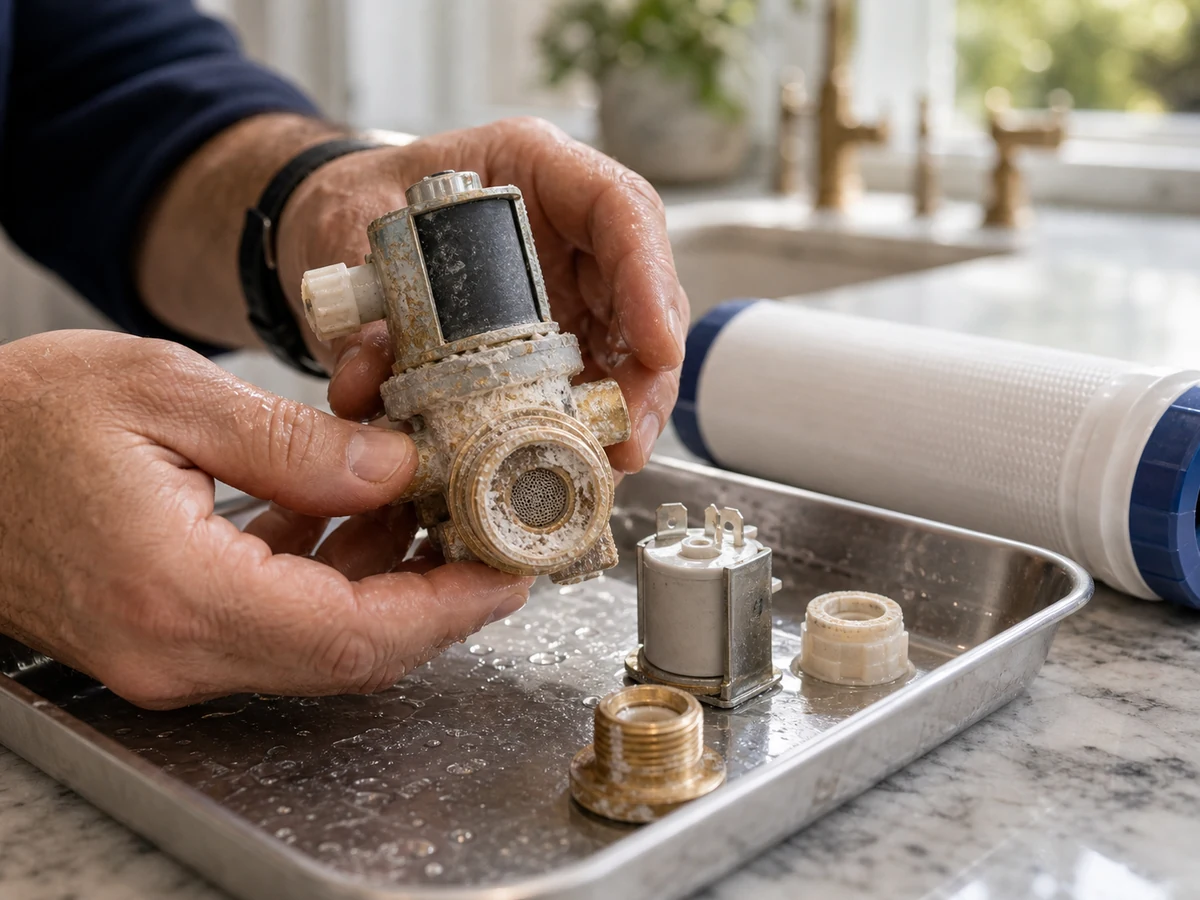
Ice making is the part of a Sub-Zero most punished by local water, and the reason is geology, not the appliance. St. Johns County and JEA supply run very hard — 14 grains per gallon and frequently well past it — so every fill cycle leaves a film of dissolved calcium and magnesium behind. Over months that film hardens on the inlet valve seat and the inlet screen until the valve can no longer open to a full charge. First the cubes shrink and go hollow; then production halts.
The same minerals plate the fill tube and, on units with a saturated or overdue filter, the restriction stacks. We see this across every community we serve, but it concentrates in the older 500 and 600 series kitchens of Sawgrass and Old Ponte Vedra, where decades of hard water have had time to do their work. The fix is rarely exotic — a descale, a fresh valve, a new filter — but it has to address the scale, not just swap the cartridge.
Symptoms, First Checks, and Cost Lanes
| What you notice | First check | Cost lane |
|---|---|---|
| Bin empty, ice maker switched on | Inlet valve and fill — water reaching the mold? | $250–$700 |
| Cubes small, hollow, or cloudy | Partially scaled valve; saturated filter | $250–$550 |
| Fill tube iced solid | Failed mold heater / thermostat, or low temp | $400–$700 |
| Motor cycles but no ice ejected | Ice-maker module / ejector assembly | $400–$700 |
| Outdoor undercounter unit not producing | Condenser airflow plus the water path | $300–$700 |
One line, one technician, no dispatch queue
(904) 902-0927How the Diagnosis Proceeds
The visit follows the water, in order. The technician confirms the household supply and the saddle or shutoff valve are open, then checks the filter age and flow. Next comes the inlet valve itself — the most common failure on this water — tested for whether it opens and admits a full charge, with the seat and screen inspected for scale. Only when the water path is proven sound do we move to the ice-maker module, the mold heater and thermostat, and the ejector mechanism.
That ordering matters because the cheap, common cause sits at the front of the line. Replacing a module on a unit whose real problem is a scaled valve just buys a second failure. On the standalone undercounter ice machines at outdoor bars we add a condenser inspection, since salt-fouled airflow there mimics a production fault and is cheaper to clear. Where the symptom turns out to be the whole cabinet rather than the ice maker, the not-cooling rundown picks up the thread.
Keeping Ice Production Healthy on This Water
Hard water is permanent, so the defense is maintenance rather than a one-time fix. A few habits keep the bin full between visits.
- Change the filter on schedule On 14-plus grain water, treat the filter interval as a floor, not a ceiling — overdue cartridges starve the ice maker first.
- Watch the cube quality Small or hollow cubes are the early warning of a scaling valve; calling then is cheaper than calling when the bin is empty.
- Keep the bin arm clear A frozen clump against the bin arm or sensor reads as a full bin and stops production — clear it before assuming a fault.
- Mind outdoor units Oceanfront undercounter ice makers want their condensers cleaned more often; salt and hard water gang up on them.
Owner Questions
Ice Maker Trouble, Asked and Answered
Why did my Sub-Zero ice maker suddenly stop making ice?
In 32082 the leading cause is the water inlet valve scaling shut. St. Johns County and JEA water runs very hard — 14 grains per gallon and often higher — and those minerals plate the valve seat and inlet screen until water can no longer fill the mold on each cycle. A clogged or frozen fill tube, a saturated water filter, or a failed mold heater and thermostat are the next suspects. We test the valve and the fill first because, on this water, it is the answer more often than not.
My ice maker still works but the cubes are small or hollow — same problem?
Usually the same root cause, caught earlier. When the fill valve is partially scaled it admits a trickle instead of a full charge, so the mold only half fills and you get small, hollow, or cloudy cubes before production stops entirely. It is the early warning of a valve heading for failure. Replacing or descaling the valve and refreshing the filter restores full cubes; left alone, the trickle becomes nothing.
Could it just be the water filter?
It often contributes. A filter past its service life restricts flow enough to starve the ice maker, and on hard local water filters load up faster than the calendar suggests. We change the filter as a matter of course during the visit, but on Ponte Vedra units the filter is rarely the whole story — the scaled inlet valve behind it is usually the real restriction, and a fresh filter alone will not clear that.
How much does a Sub-Zero ice maker repair cost here?
Most ice-maker repairs in 32082 land between $250 and $700. A descale-and-filter service is at the lower end; a scaled inlet valve replacement sits in the middle; a failed ice-maker module, mold heater or thermostat reaches the upper end. The diagnostic service call is $185–$295 and the binding figure follows testing at the unit. The standalone undercounter ice machines at outdoor bars can run a touch higher because of their exposure and tighter installs.
Why do outdoor and undercounter ice makers fail faster in Ponte Vedra Beach?
Because they take the coast head-on. A summer-kitchen undercounter ice unit at an oceanfront bar lives in direct salt air with no cabinet shelter, so its condenser fouls and its components corrode faster than a kitchen unit, while the same hard water scales its valve and screens. We see these on a tighter maintenance interval, and we check the condenser airflow along with the water path on every visit.
Is there anything I can safely check before I call?
A few things, none of which touch the sealed system. Confirm the ice maker is switched on and the bin arm or sensor is not blocked by a frozen clump. Check that the household water supply and the saddle or shutoff valve to the refrigerator are fully open. Note when the filter was last changed. And give a recently restarted unit up to 24 hours, since a Sub-Zero ice maker takes time to resume full production. If it is still empty past that, the valve or fill path is the likely culprit and a call is due.
Arrange a Visit to Your Kitchen
Telephone hours run Monday through Saturday, 7:30 to 6:30. Same-week appointments across 32082, gate access arranged in advance.