Service Line · Ice Production
Sub-Zero Ice Maker Repair in Hard-Water Ponte Vedra
The aquifer under this coast is generous with minerals. Your ice maker keeps the receipts — until we clear them.
Ice maker complaints in Ponte Vedra Beach are usually water problems: the 32082 supply runs 14–28 grains per gallon, hard enough to scale a Sub-Zero fill valve shut within a few years. Sub-Zero Repair Ponte Vedra descales, replaces inlet valves and filters, and restores full production — most visits close between $250 and $700.
For Sub-Zero repair across Ponte Vedra Beach — Sawgrass, Marsh Landing and the oceanfront — call (904) 902-0927 or Book online.
The Local Variable
Why Ice Makers Struggle on This Water
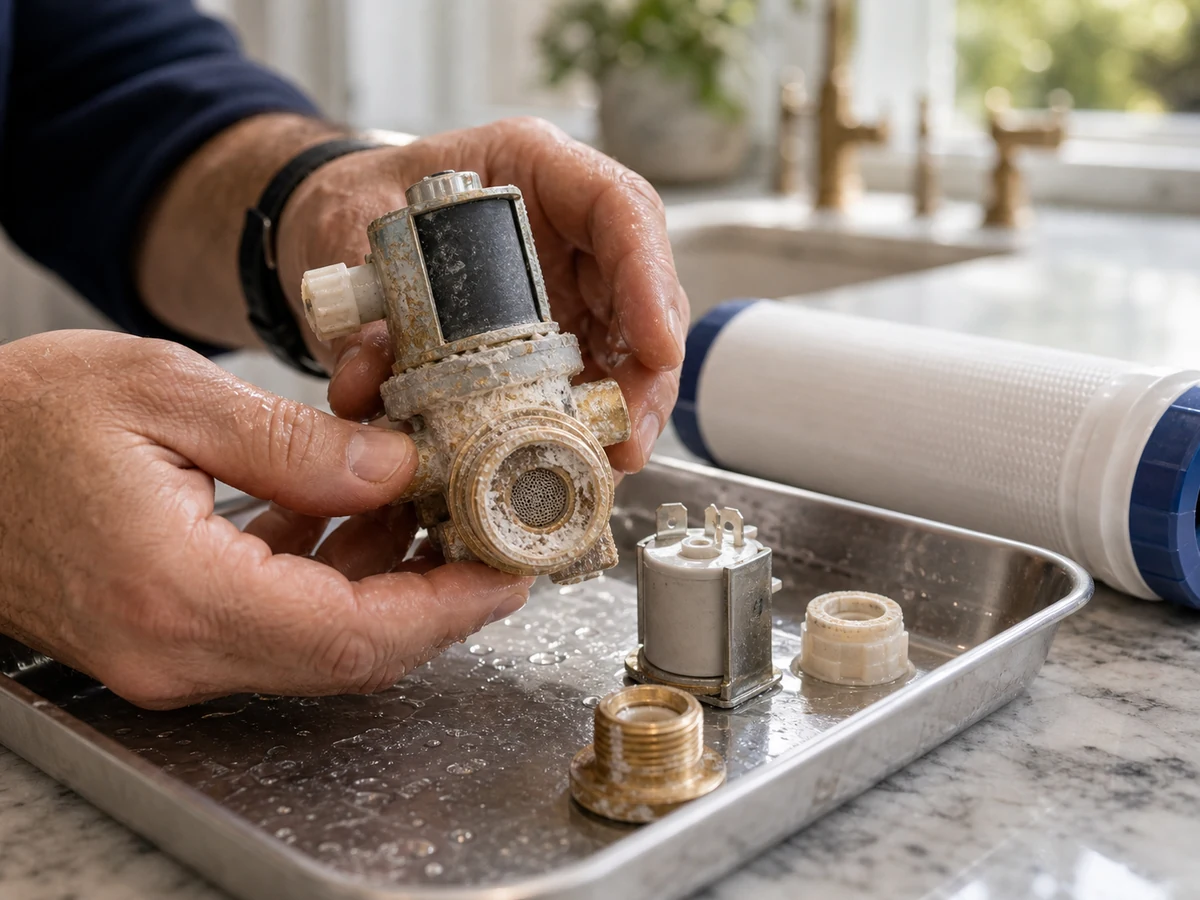
Everything west of the dune line drinks from the Floridan aquifer, and that water arrives carrying dissolved limestone — 14 grains per gallon on a good day, up toward 28 in the hardest pockets of St. Johns County. Each harvest cycle leaves a trace of that mineral load behind: on the inlet screen, inside the valve, along the mold cavities. The ice maker does not break so much as silt up.
The pattern repeats across the household fleet. Estates along the Boulevard and in Marsh Landing typically run two or three refrigeration units plus an undercounter ice machine at the bar or summer kitchen, and the undercounter units fail soonest — they make ice continuously, concentrating scale faster than a freezer-mounted maker ever will. Outdoor installations collect salt air on top of the mineral problem; the coastal care guide gives those units their own maintenance calendar.
Production also depends on cold the ice maker does not make for itself. A freezer drifting above 0°F stretches every cycle, so when output sags we verify compartment temperature before blaming the maker — sometimes the honest fix lives on the freezer line instead.
Signs, Causes, and the Repair Lane Each One Lands In
| Sign at the bin | Underlying cause | Repair lane |
|---|---|---|
| Small, hollow, or cloudy cubes | Restricted fill — scaled valve or aged filter | $250–$550 |
| Production halved over months | Mineral buildup through the water path | $250–$700 |
| No ice, maker silent | Failed valve solenoid or control fault | $550–$900 |
| Water overrunning the mold | Valve not seating — replacement, not cleaning | $550–$700 |
| Stale-tasting ice | Spent filter, bin needing sanitation | $250–$400 |
One line, one technician, no dispatch queue
(904) 902-0927What the Ice Maker Visit Actually Includes
- Flow and fill test. We measure what the valve delivers per fill against specification — the single number that separates a water problem from a control problem.
- Electrical check. Solenoid coil resistance and module behavior. The 1996–2008 classics have a known fault where a solenoid energized beyond fifteen seconds trips the board — the 600 series notes explain why that matters for diagnosis.
- Descale and component renewal. Valve, screen, and mold treated or replaced as the readings dictate. On built-ins from the 2008–2022 run, the water inlet valve is a stocked truck part — the BI series page covers that generation’s habits.
- Filter and verification. A fresh filter, dated, and a full harvest cycle observed before we leave. Production is confirmed, not promised.
On this water, treat ice maker service as a rhythm rather than a rescue: a valve-and-filter visit every few years costs a fraction of an emergency call the week guests arrive for THE PLAYERS.
Descaling Intervals by Where the Unit Lives
On 14-to-28-grain water the right service interval is not one number — it depends on how hard the maker works and what air it breathes. These are the rhythms we set for the placements common in 32082.
| Where it sits | Filter change | Descale & valve check |
|---|---|---|
| Freezer-mounted maker, conditioned kitchen | Every 6 months | Every 2–3 years |
| Undercounter ice machine, bar or pantry | Every 6 months | Annually — it runs continuously |
| Outdoor or summer-kitchen unit near the surf | Every 6 months | Annually, with a coil clean for salt |
| Seasonal home, shuttered part of the year | At each reopening | At reopening, plus a fresh charge of water through the line |
Is It the Ice Maker, or the Cold Behind It?
An ice maker cannot make ice faster than the freezer can chill it, so a production complaint is sometimes a freezer complaint wearing the wrong name. The way to tell them apart is the cube itself. Small, hollow, or cloudy cubes at normal speed are a water-path problem — a scaled valve or a spent filter restricting fill — and they stay on this line. Full-size cubes arriving too slowly, or a harvest that stalls, points past the maker to a freezer that has drifted above 0°F.
So before we order a valve we read the freezer temperature, because replacing the maker on a warm freezer fixes nothing. If the compartment is the real culprit, the work moves to the freezer repair line, where a defrost fault or a tired seal is the usual cause. And on built-ins, a maker that quit entirely after a storm is a board question rather than a water one — the BI series notes cover that path.
Which Water Component Fails, by Generation
Sub-Zero changed the ice-maker water path across the series, so naming your generation narrows the suspect before we arrive. The 14-to-28-grain supply is the constant; what it attacks differs by unit.
| Generation | Where scale strikes first | The known quirk |
|---|---|---|
| 600 series (1996–2009) | Fill solenoid and inlet screen | A solenoid energized beyond ~15 seconds can fault the board |
| BI built-ins (2008–2022) | Water inlet valve seat | Valve is a stocked truck part; solenoid wears with scale |
| Undercounter UC machines | Mold and full water path | Continuous production concentrates scale fastest |
| UC-15I ice machine | Drain and reservoir | Gravity-drain models silt up before pump-drain ones |
What Keeps Production Up Between Visits
On this aquifer, a little owner attention stretches the interval between service calls. None of it touches the sealed system — it is the water side an owner can safely manage.
- Change the filter on the six-month clock Twelve months is too long here; a filter loaded with aquifer minerals throttles fill and shrinks the cubes well before its calendar date.
- Empty and wipe the bin periodically A bin left full lets old cubes fuse and absorb odors; clearing it now and then keeps the harvest honest and the ice tasting clean.
- Flush the line at a seasonal reopening A shuttered seasonal home should run fresh water through the supply before trusting the first batch — standing water sheds scale and taste into the mold.
- Watch the trend, not the day Falling output with no change in use is the cue to book a descale and valve check before a slow restriction becomes a stopped maker.
Owner Questions
Ice Maker Questions We Hear Locally
Why does my Sub-Zero ice maker make less ice in summer?
Two seasonal forces stack up. Warmer incoming water and a harder-working freezer slow each harvest cycle, and summer is when households here draw the most ice — so a fill valve already half-closed by scale finally shows itself. A unit producing comfortably in February can fall visibly behind by June without any new part having failed.
Does hard water around Ponte Vedra really shorten ice maker life?
Measurably. The supply in 32082 draws from the limestone Floridan aquifer and tests between 14 and 28 grains per gallon — firmly in the “very hard” band. Minerals plate onto the inlet screen, the valve seat, and the mold itself, so components that last a decade on soft water need attention here in three to five years.
Should the whole ice maker be replaced, or just the water inlet valve?
We test before deciding, because the valve is the culprit in most cases and costs far less. If the mold, ejector, and module check out and the valve is merely restricted, a valve and descale brings production back. Full assemblies are reserved for units with worn molds or failed modules — we show you the readings either way.
How often should the water filter change on this supply?
Every six months is the right rhythm in this ZIP, not the twelve the calendar-minded default to. Past that point a filter loaded with aquifer minerals throttles flow, the valve compensates poorly, and cubes come out small or hollow. We date the filter at every visit so the next change is never a guess.
Why is the ice cloudy or white rather than clear on this water?
Cloudiness is dissolved minerals coming out of solution as the cube freezes — and at 14 to 28 grains per gallon, this water carries a heavy load of them. It is a cosmetic and taste issue more than a fault, but the same minerals that cloud the cube are plating the valve and screen at the same time. A fresh filter and a descale clear most of it; persistently chalky cubes usually mean the filter is past due.
Should I add a softener or whole-house filter to protect the ice maker?
It helps, with a caveat. A whole-house softener or a dedicated under-sink filter on the refrigerator line measurably slows scaling of the valve, screen and mold, which is worth it on equipment this expensive. The caveat is that softened water still needs the appliance filter changed on schedule, and outdoor or summer-kitchen makers near the ocean face salt on top of minerals — those still want the coastal maintenance calendar regardless.
The ice maker leaks water into the bin or onto the floor — what causes that?
Overflow almost always means the water inlet valve is no longer seating. Hard-water scale builds on the valve seat until it cannot close fully, so water keeps trickling after the fill cycle ends, floods the mold, and runs into the bin or down the cabinet. It is a replacement rather than a cleaning, since a valve worn past seating will not be rescued by descaling — a $550–$700 repair that also stops the slow water damage a chronic leak does to cabinetry.
How long should a Sub-Zero ice maker take to refill the bin after I empty it?
A healthy freezer-mounted maker harvests a batch every couple of hours and refills a bin over a day or so; an undercounter machine runs faster because it makes ice continuously. On this water the honest tell is the trend, not a stopwatch — a maker that filled the bin overnight in winter but now needs two or three days, with no change in use, is reporting a fill restricted by scale. That is the point to descale and check the valve before output drops further.
Arrange a Visit to Your Kitchen
Telephone hours run Monday through Saturday, 7:30 to 6:30. Same-week appointments across 32082, gate access arranged in advance.