Service Line · Sealed Systems
Sub-Zero Sealed System Repair in Ponte Vedra
Refrigerant leaks and failing compressors — the deep refrigeration work most companies decline, and the reason this practice exists.
Sub-Zero Repair Ponte Vedra repairs Sub-Zero® sealed systems across Ponte Vedra Beach and the 32082 ZIP — evaporator leaks and compressor failure handled on our own bench, not a subcontractor's. Book at (904) 902-0927 or online. This is the most expensive lane, $1,500–$3,000 for evaporator work, so we quote only after airflow, electrical and pressure evidence agree.
For Sub-Zero repair across Ponte Vedra Beach — Sawgrass, Marsh Landing and the oceanfront — call (904) 902-0927 or Book online.
The Deep Work
What Sealed-System Repair Actually Involves
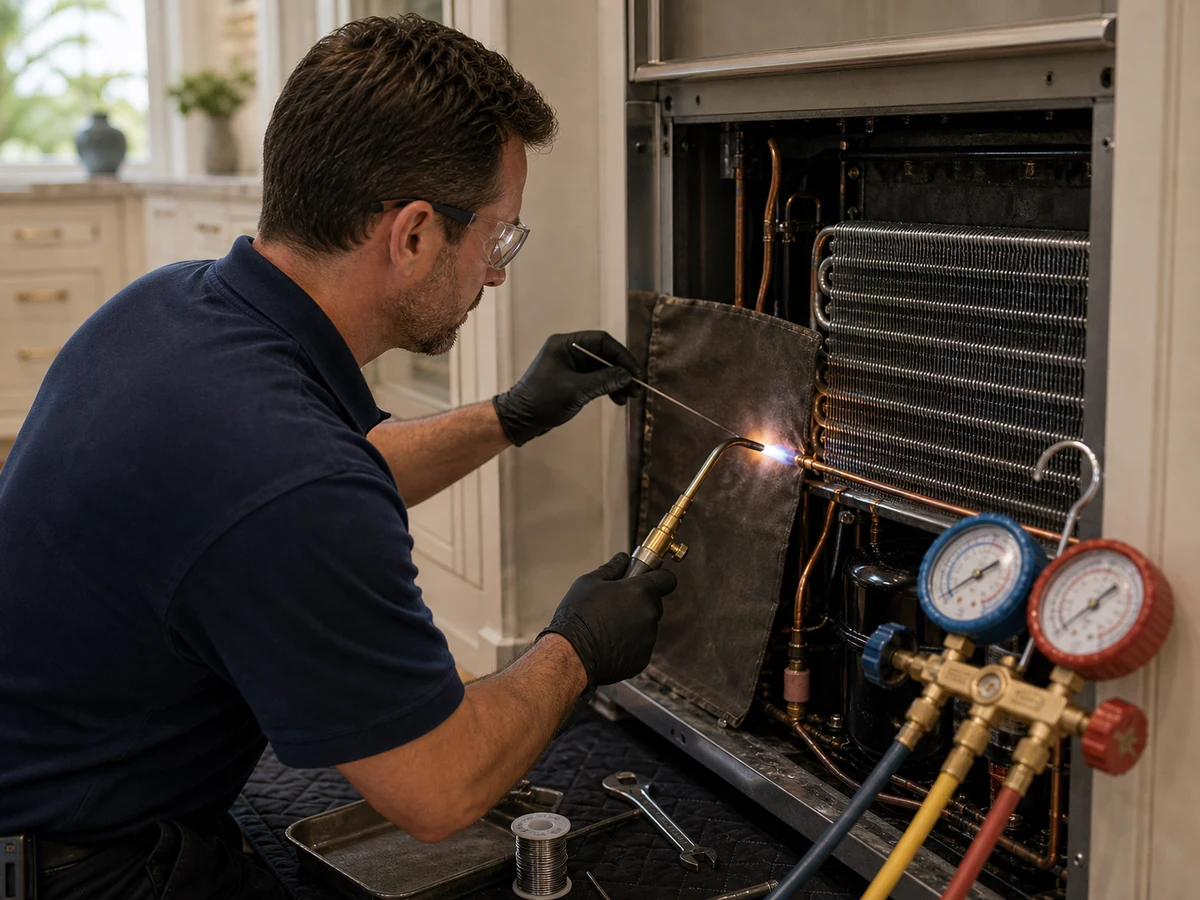
The sealed system is the closed refrigeration loop at the heart of every Sub-Zero — compressor, condenser, evaporator and the refrigerant moving between them, brazed shut and never opened in routine service. When it fails, no control setting brings the cabinet back; the loop itself has to be cut into, repaired or its failed component replaced, then evacuated and recharged to spec.
Most local companies stop short of this work. They will swap a board or a gasket and decline anything requiring brazing and a vacuum pump, which is why a leaking classic so often gets a replacement quote it does not need. The deeper refrigeration tier is the center of this practice, not the edge of it — the 500 series evaporator leak is the repair we do most.
The Evidence We Require Before a Quote
| Step | What we read | What it rules in or out |
|---|---|---|
| Airflow | Condenser condition, fan operation | A choked coil that mimics sealed-system failure |
| Electrical | Compressor draw, start components | A start relay or capacitor, not the compressor |
| Frost pattern | How much of the evaporator carries frost | A partial-frost refrigerant leak |
| Pressure | Gauges on the system, both sides | Charge level and the failed component |
One line, one technician, no dispatch queue
(904) 902-0927Sealed-System Repairs and Their Ranges
Two outcomes dominate this line. A refrigerant leak — most often a fresh-food evaporator on a 500 or 600 series classic — frosts only the first few inches of the coil and leaves the unit running constantly without cooling; the repair runs $1,500–$3,000 depending on the component and access. A failed compressor, confirmed on draw and pressure rather than assumed, runs $1,000–$2,000. Either way the figure is written, itemized, and approved before the brazing torch comes out.
Because this is the costly lane, it is also where an honest verdict matters most. On a sound classic the repair beats replacement by a wide margin; on a unit with a stacked history it may not, and we say so. The repair-or-replace guide carries the full decision, and for the units that fill Sawgrass and Marsh Landing kitchens, getting it right is worth far more than the service call.
How the Repair Itself Is Carried Out
Once the evidence is in and the quote approved, the work follows a sequence that is unglamorous and exacting in equal measure. The steps an owner never sees are the ones that decide whether the repair lasts years or fails by the next storm season.
- Recover the charge The existing refrigerant is recovered properly rather than vented, and the original type is confirmed from the data tag — R-12 on the earliest classics, later blends after.
- Repair or replace the component The leaking evaporator or failed compressor is removed and the new part brazed in with the cabinetry and floors protected, the unit pulled where access demands.
- Pressure-test and leak-check The repaired loop is held under pressure and checked for leaks before anything goes back in — finding a second leak now is far cheaper than finding it in August.
- Deep vacuum The system is evacuated to pull out moisture and non-condensables; skipping this is the single most common reason a recharge fails early.
- Weigh in the charge and verify Refrigerant is weighed in to spec, the unit run, and pressures and cabinet temperatures confirmed over the 24-hour stabilization window.
When Sealed-System Work Pays, and When It Does Not
Because this is the costly lane, the verdict matters more than the diagnosis. This is the framework we use out loud with an owner before any torch comes out.
| Unit condition | Evidence we look for | Usual recommendation |
|---|---|---|
| Single leak, sound compressor and cabinet | One frost-line leak, clean interior, first repair | Repair — beats $14,000 replacement easily |
| Compressor failed, everything else intact | Confirmed draw and pressure failure, no corrosion | Repair on a classic worth keeping |
| Second compressor or repeat leak | Prior sealed-system history on the same unit | Discuss honestly; repair often still wins, not always |
| Corroded cabinet or multiple leaks | Salt damage, several leak points, aged interior | Replacement may be the wiser spend |
| Kitchen slated for a gut renovation | Cabinetry changing regardless | Weigh replacement into the remodel budget |
Why Sealed Systems Fail Earlier on This Coast
A Sub-Zero sealed system is engineered to outlast the kitchen around it, so when one fails early there is usually a local reason. The first is salt: a condenser left fouled within reach of the surf runs hot, head pressure climbs, and the compressor labors against heat it cannot shed — years of that strain age the loop from the outside in. The second is the leak itself. On the classics that fill Sawgrass and Old Ponte Vedra, the fresh-food evaporator is the weak point, and the 561 in particular corrodes through there often enough to be a signature failure of the series.
The third factor is age plus refrigerant chemistry. The earliest 500 units ran on R-12, and a thirty-year-old loop that has cycled tens of thousands of times eventually finds a pinhole at a joint or a coil bend. None of these condemn the machine — a single leak on a sound compressor and cabinet is a confident repair — but they explain why so much of this work lives in 32082 specifically. The 500 series notes map which models carry the most risk, and the coastal care calendar covers the condenser discipline that keeps a sound loop sound.
Reading the Cooling Pattern Before the Gauges
Sealed-system work is the costly lane, so the diagnosis starts with evidence anyone can see — how the cabinet cools and where the coil frosts. The pattern points the gauges; it never replaces them.
| Cooling pattern | What it suggests | First check before gauges |
|---|---|---|
| Runs nonstop, frost on only the first inches of coil | Refrigerant leak starving the evaporator | Rule out a fouled condenser, then gauge it |
| Runs nonstop, evaporator iced solid and even | Defrost fault, not the sealed system | Test the defrost heater and thermostat |
| Compressor hot, clicks, will not stay running | Start components or a failing compressor | Check start relay and capacitor, then draw |
| One side warm, other side cold (PRO 48) | A fault on that side’s independent system | Isolate and gauge only the warm circuit |
Owner Questions
Sealed-System Repair, Asked and Answered
What exactly is the sealed system on a Sub-Zero?
The sealed system is the closed refrigeration loop — compressor, condenser, evaporator, and the refrigerant circulating between them, all brazed shut and never meant to be opened in normal service. When it fails, the cabinet cannot reach temperature no matter what the controls do. Sealed-system work means cutting into that loop to repair or replace a component, then evacuating and recharging it correctly.
Why do you require evidence before quoting compressor or evaporator work?
Because it is the most expensive lane and the easiest to misdiagnose. A compressor quote written before the condenser, airflow and electrical have been checked is a four-figure guess — and a choked condenser or a tired fan mimics sealed-system failure convincingly. We put gauges on the system, document pressures and the frost pattern, and quote only when the evidence agrees. That order protects your wallet from a wrong diagnosis.
Can a sealed-system repair really be done in a Ponte Vedra home kitchen?
Yes, with the right setup. Brazing, evacuation and recharge happen on site for most repairs, with protection laid down for the cabinetry and floors and the unit pulled where access demands it. Larger units like the PRO 48 are two-technician jobs. What we will not do is rush a sealed-system repair — proper evacuation and a leak-checked charge are what make it last years rather than months.
Is a refrigerant leak worth fixing on a thirty-year-old unit?
On a sound classic, almost always. A single evaporator leak on a unit whose compressor and cabinet are intact is a confident repair in the $1,500–$3,000 lane, set against a built-in replacement that opens near $14,000. The exceptions — multiple leaks, a second-time compressor, a corroded interior — we name honestly. The full arithmetic lives in our repair-or-replace guide.
How long should a properly done sealed-system repair last?
Done correctly, the rest of the unit’s natural life — many years, not months. The difference is in the steps owners never see: a leak found and fixed rather than just topped up, the system pulled into a deep vacuum to remove every trace of moisture before recharging, and the charge weighed in to spec rather than guessed. A rushed recharge over an unfound leak fails by the next season; that is why we do not rush this lane.
Does the older R-12 refrigerant in a classic Sub-Zero complicate the repair?
It is a known factor, not a dealbreaker. The earliest 500 series units ran on R-12, which is no longer produced, so a sealed-system repair on one is handled with recovered or approved drop-in refrigerant and the charge set to match the system. We confirm the original refrigerant from the data tag before opening the loop and plan the recharge accordingly — it is part of why the model and serial matter before this work begins.
How is a sealed-system fault on a PRO 48 different from one on a built-in?
A standard built-in or classic has one sealed system, so a refrigerant fault affects the whole cabinet. A PRO 48 carries two independent systems — separate compressors and evaporators for the fresh-food and freezer sides — so one side can fail while the other runs perfectly, and each is diagnosed on its own gauges. That doubles the diagnosis and means a quote names which side and which component; a finding on one circuit tells us nothing about the other. The per-side approach is covered on the PRO 48 page.
Why did my unit cool fine for years and then suddenly lose its charge?
Refrigerant does not get consumed — a sealed loop that loses charge has developed a leak, and leaks usually start small and grow. On a classic the common origin is the fresh-food evaporator corroding through after decades, often hastened on this coast by salt that reaches the coil through a long-fouled condenser. A unit that cooled well and then declined over weeks fits the leak pattern exactly, which is why we find and fix the leak rather than simply topping up a charge that will only bleed away again.
Arrange a Visit to Your Kitchen
Telephone hours run Monday through Saturday, 7:30 to 6:30. Same-week appointments across 32082, gate access arranged in advance.