Problems We Fix · Ponte Vedra Beach
Sub-Zero Warm or Dark Panel After a Power Outage in Ponte Vedra Beach
Lights on, panel blank, cabinet warming the morning after a storm. In lightning country that pattern has a name — and it is not always a dead unit.
When a Sub-Zero in Ponte Vedra Beach goes warm or shows a blank, unresponsive panel after a power outage, the cause is usually the restoration surge — a voltage spike that puts the control board into a “brownout lock” (power present, panel dead) or damages the condenser-fan triac. Check power and give it 24 hours first; a clean reset sometimes clears it. If not, board diagnosis runs from the $185–$295 diagnostic up to roughly $1,300 for a surge-killed board. Whole-home surge protection prevents the repeat.
For Sub-Zero repair across Ponte Vedra Beach — Sawgrass, Marsh Landing and the oceanfront — call (904) 902-0927 or Book online.
Sub-Zero Repair Ponte Vedra handles post-storm calls across the 32082 ZIP with a diagnosis-first house call: the line at (904) 902-0927 answers Monday through Saturday, and the external booking page takes appointments at any hour.
What Actually Happened
The Mechanism: A Restoration Surge, Not a Dead Compressor
The outage itself rarely harms a Sub-Zero. The damage comes at the end of it. When the grid restores power after a lightning event or a storm knockout, the voltage often returns 50 to 100 percent over nominal for a fraction of a second before it settles. Built-in Sub-Zero control boards are notably sensitive to that spike, and it tends to produce one of two outcomes.
Brownout lock
The board survives the spike but its logic latches into a protective, unresponsive state. Power and the interior lights stay on — which is why owners assume the unit is fine — yet the panel is dark or frozen and the compressor will not start. The board is, in effect, waiting for a clean restart it never received. A proper power cycle sometimes releases it.
Condenser-fan triac damage
The surge can also punch through a specific component on the board — most commonly the triac that switches the condenser fan. The unit may light up normally and even show a display, but the fan never runs, head pressure climbs, and the cabinet drifts warm. This is a board-section repair, not a whole-unit failure, and it is one of the more common surge casualties we find here.
Before You Call
What to Check First, Cheapest Cause Up Top
Two of these steps cost nothing and resolve a meaningful share of post-storm calls. Work them in order before assuming the worst.
- Confirm real power. Check the dedicated breaker and, on the beaches, any GFCI feeding the kitchen or butler’s pantry. A tripped breaker after a surge looks exactly like a dead unit.
- Give it 24 hours. If power only just returned, a Sub-Zero is allowed a full day to restabilize at 38°F fresh food and 0°F freezer. Warm past that window means something genuinely failed.
- Power-cycle the unit. Switch it off at its dedicated breaker, wait a couple of minutes, switch it back on. A true brownout lock sometimes clears on this clean restart.
- Read the panel. Still blank, frozen, or warm with the fan silent after all of the above? That is the board, and it is the point to call rather than keep resetting.
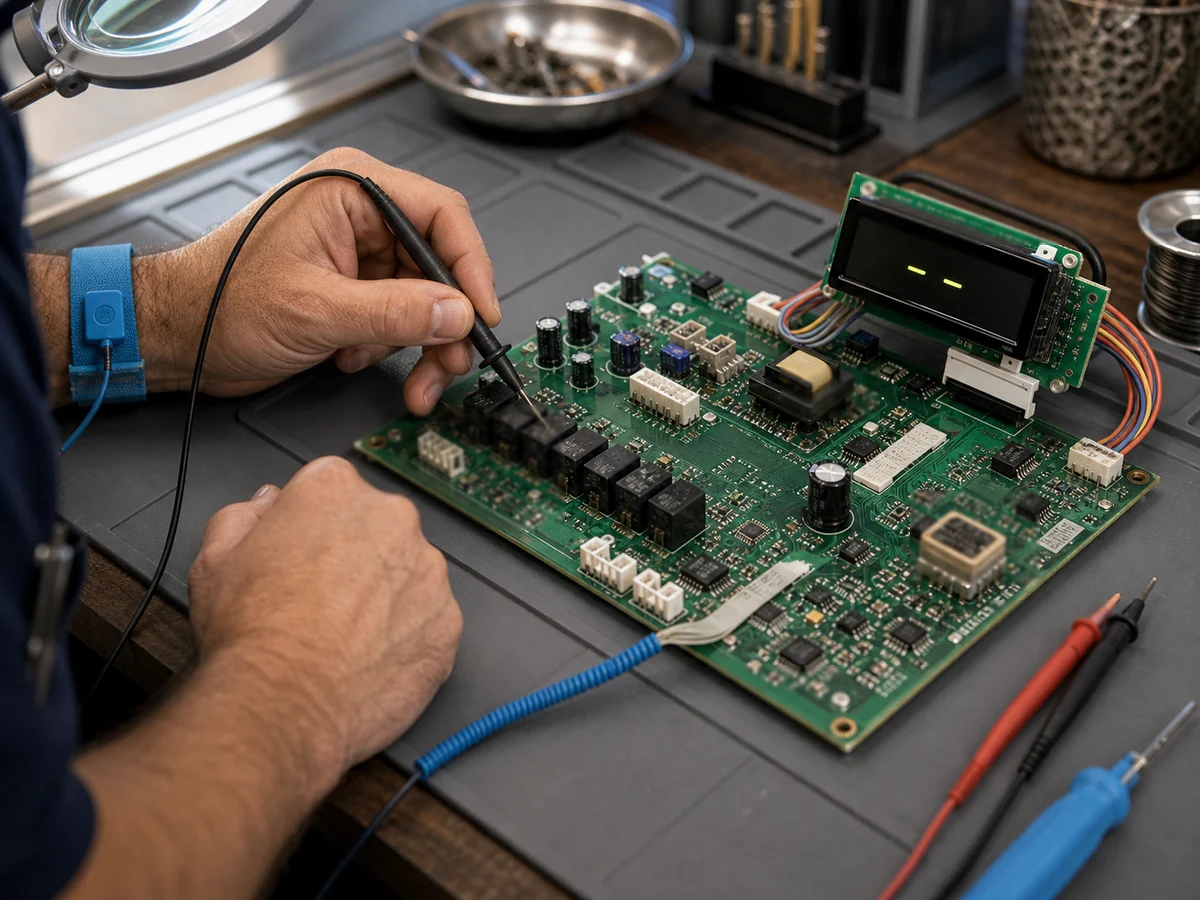
Reset vs Board Work
Honest Cost Bands for a Post-Outage Sub-Zero
The price swings widely because the outcomes genuinely differ — a reset and a dead board are worlds apart. The table maps what the surge did to the cost lane; the binding figure follows diagnosis at the unit.
| What the surge did | Evidence at the unit | Cost lane |
|---|---|---|
| Tripped breaker / GFCI only | Power restored on reset; unit runs normally | No-charge to $185 |
| Brownout lock the reset clears | Panel wakes after a clean power cycle and reseat | $185–$295 |
| Condenser-fan triac damaged | Display on, fan silent, cabinet drifting warm | $550–$1,100 |
| Sensor or thermistor knocked out | Erratic readings or dashes; resistance off-reference | $550–$1,100 |
| Control board killed by the surge | No board response after power and reset checks pass | $900–$1,300 |
If the board comes back but the unit still will not cool, the trail rejoins the broader not-cooling rundown; if it wakes showing a numeric warning instead of a blank screen, the EC error-code page reads it.
One line, one technician, no dispatch queue
(904) 902-0927Local Conditions
Why 32082 Lives This Every Storm Season
This is not a rare failure here — it is a seasonal one. Northeast Florida records more than a hundred thunderstorm days a year, and Florida leads the United States in cloud-to-ground lightning. Every outage, large or small, ends with a restoration surge, and the built-in boards common in oceanfront and gated estate kitchens are exactly the hardware that surge targets.
Two local realities multiply the exposure. First, the housing: many Old Ponte Vedra, Sawgrass, and Marsh Landing homes run their original late-1980s-to-1990s units, whose boards have already weathered decades of spikes. Second, the density — estate kitchens here routinely carry two or three refrigeration units plus wine storage, so a single afternoon storm can leave more than one panel dark in the same house. The coastal care guide folds surge protection into the same calendar that handles salt and humidity.
Prevent the Repeat
Surge Protection Is Cheaper Than the Next Board
The single most effective step against this fault is a whole-home surge protector installed at the electrical panel — roughly $900 to $1,200 — which clamps the restoration spike before it ever reaches the refrigerator. Pair it with a dedicated circuit for each Sub-Zero so one appliance does not share another’s hit. For a household running multiple built-ins in lightning country, the math is plain: one prevented board generally covers the protector, and the protector guards every other piece of electronics in the house at the same time. It will not undo damage already done, which is why the time to install it is before the next storm, not after.
From the Field
Diagnostic Case Notes
Educational diagnostic scenarios, not customer reviews.
Ponte Vedra Boulevard, BI built-in. Morning after a summer squall: interior lights on, panel dead, cabinet rising. The breaker held and a clean power cycle woke the board on the second try — a textbook brownout lock that released on a proper restart. The visit closed at the diagnostic band, and we flagged the lack of surge protection as the reason it would recur.
Marsh Landing, built-in side-by-side. Display lit normally, but the condenser fan never ran and the cabinet crept warm over a day. The surge had taken out the condenser-fan triac on the board. A board-section repair restored normal cycling — far short of a whole-unit replacement, and a reminder that a lit panel does not mean the surge missed.
Sawgrass, two units one storm. A single lightning outage left a kitchen built-in locked and a butler’s-pantry unit unaffected because the pantry circuit happened to carry a point-of-use protector. The contrast made the case for whole-home protection better than any sales sheet could.
Owners Ask
Post-Outage Questions from 32082 Kitchens
My Sub-Zero has interior lights but the control panel is blank and the cabinet is warming. What happened?
That specific pattern — power clearly present, lights on, but a dark and unresponsive panel — is the classic restoration-surge signature on a built-in. When power comes back after an outage it often returns 50 to 100 percent over nominal voltage, and that spike can put the control board into a brownout lock: the logic is alive enough to feed the lights but the board will not run the compressor or refresh the display. It usually needs board diagnosis, sometimes a simple power-cycle reset, occasionally a board.
Should I try anything before I call?
Yes — two safe steps. First, give the unit its full 24-hour recovery window if power only just returned; Sub-Zero allows that long to restabilize at 38°F fresh food and 0°F freezer. Second, do a clean power cycle: switch the unit off at its dedicated breaker, wait a couple of minutes, and switch it back on. A genuine brownout lock sometimes clears on a proper reset. If the panel stays dark or the cabinet stays warm past 24 hours, the board needs eyes on it.
How much does this cost to fix?
It runs a wide band because the outcomes are genuinely different. A reset or a connector reseat that brings the board back falls in the diagnostic range of $185–$295. A failed condenser-fan triac or a sensor knocked out by the surge lands around $550–$1,100. A control board that the surge actually killed is the top of the lane. We diagnose first and quote in writing before any part is opened, so you know which outcome you are in.
Why does this happen so often here compared to where I used to live?
Northeast Florida logs more than a hundred thunderstorm days a year, and Florida leads the country in cloud-to-ground lightning strikes. Every outage ends with a restoration surge, and built-in Sub-Zero boards are notably sensitive to it. Households along Ponte Vedra Boulevard and inside Sawgrass and Marsh Landing see this every storm season — often on more than one unit at once, since estate kitchens here routinely run two or three plus wine storage.
Is the food still safe after the outage?
A loaded, closed Sub-Zero holds safe temperatures for several hours. Move what matters most — dairy, seafood, medication — to a cooler or a second unit, but otherwise keep the door shut. Avoid setting bagged ice inside the compartments; the meltwater finds the drain pan and can muddy the diagnosis. If the cabinet has been warm well past the 24-hour recovery window, treat the contents by normal food-safety rules.
Will a surge protector actually stop this from happening again?
It is the most effective prevention there is for this fault. A whole-home surge protector, installed at the panel for roughly $900–$1,200, clamps the restoration spike before it reaches the board, and a dedicated circuit for each Sub-Zero keeps a single appliance from sharing the hit. It will not undo damage already done, but for a household running multiple built-ins in lightning country it usually pays for itself the first storm season it prevents a board.
Could a blank panel be something other than a surge?
It can. A tripped breaker or a GFCI in a butler’s pantry mimics a dead unit, which is why the power check comes first. A failed board can also simply age out without a storm. But when the panel went dark or the cabinet went warm in the same window as a recent outage or a nearby lightning strike, the restoration surge is the leading suspect and the one we test for first.
Arrange a Visit to Your Kitchen
Telephone hours run Monday through Saturday, 7:30 to 6:30. Same-week appointments across 32082, gate access arranged in advance.