Service Line · Wine Storage
Sub-Zero Wine Cooler Repair in Ponte Vedra Beach
A cellar in cabinet form deserves cellar-grade discipline. We keep both zones honest — to the degree.
A Sub-Zero wine cabinet in Ponte Vedra Beach usually fails by degrees — a thermistor drifting two or three degrees, an evaporator icing in a humid butler’s pantry. Sub-Zero Repair Ponte Vedra services the 400 series through current models across 32082; most corrections land between $550 and $1,100.
For Sub-Zero repair across Ponte Vedra Beach — Sawgrass, Marsh Landing and the oceanfront — call (904) 902-0927 or Book online.
Failure by Degrees
How Wine Storage Fails Without Announcing It
A refrigerator that quits gets noticed by dinnertime. A wine cabinet holding 62°F instead of 55°F can go a season before anyone checks — and the bottles pay the interest. The common faults are unglamorous: dual-zone thermistors drift with age, evaporators ice over when humid air finds a tired seal, and condensate paths clog in placements the original installer never imagined working this hard.
The installed base here is mostly the 400 series — 424 and 427 cabinets fitted to butler’s pantries and bar walls during the big remodel years, 1999 through the mid-2010s — joined lately by BW and IW units and the current wine columns. All of it is serviceable, and on a cabinet protecting a few thousand dollars of wine, a $550 sensor correction is not a hard decision.
When icing is severe enough to suggest refrigerant loss rather than moisture, the case moves to the same proof-first standard as our sealed-system work — gauges before quotes, in writing.
What the Cabinet Tells You, and What We Test
| Reading at the cabinet | What we test | Cost picture |
|---|---|---|
| Zone holds 5°F+ off set point | Thermistor accuracy against reference | $550–$900 |
| Both zones warm, unit running | Condenser, then evaporator for icing | $250–$1,100 |
| Moisture pooling inside | Door seal and condensate drain path | $250–$700 |
| Vibration or new hum | Fan bearings and compressor mounts | $250–$550 |
| Cabinet dead after a storm | Board and power path — surge damage | $550–$1,100 |
One line, one technician, no dispatch queue
(904) 902-0927Placement Decides the Maintenance Calendar Here
In this ZIP a wine unit’s address inside the house matters as much as its model number. A cabinet in a conditioned butler’s pantry off a Marsh Landing kitchen lives an easy life. The same cabinet at an outdoor bar facing the Atlantic — and the estates along Ponte Vedra Boulevard are fond of exactly that arrangement — breathes salt and saturated air all summer, so its condenser and seals age on the oceanfront schedule: gasket renewal every three to four years and coil care every quarter.
Storm season earns a mention of its own. Northeast Florida’s lightning count is the highest in the country, and the restoration surge after an outage is harder on wine-unit electronics than the outage itself. A cabinet that never recovered after a summer storm is a board case, not a compressor case, more often than not. The salt-air care guide covers the protective routine — and entertaining households planning around THE PLAYERS in March do well to have zones verified in February, while the calendar is still forgiving.
The Wine Cabinets We See in 32082, by Generation
Most local wine storage falls into a handful of families, each with its own build years and its own quirks. Knowing which one you own shapes both the diagnosis and the parts conversation.
| Family | Build years | What tends to need attention |
|---|---|---|
| 424 / 424G glass-door | 1999–2016 | Dual-zone thermistor drift; door-seal condensation |
| 427 / 427RG | 1999–2015 | Evaporator icing in humid pantries; fan bearings |
| WS-30 contemporary | 2009–2016 | Control and sensor faults; condensate path |
| IW / BW integrated columns | 2015–2021 | Flush-install access; integrated controls |
What a Wine-Cabinet Visit Walks Through
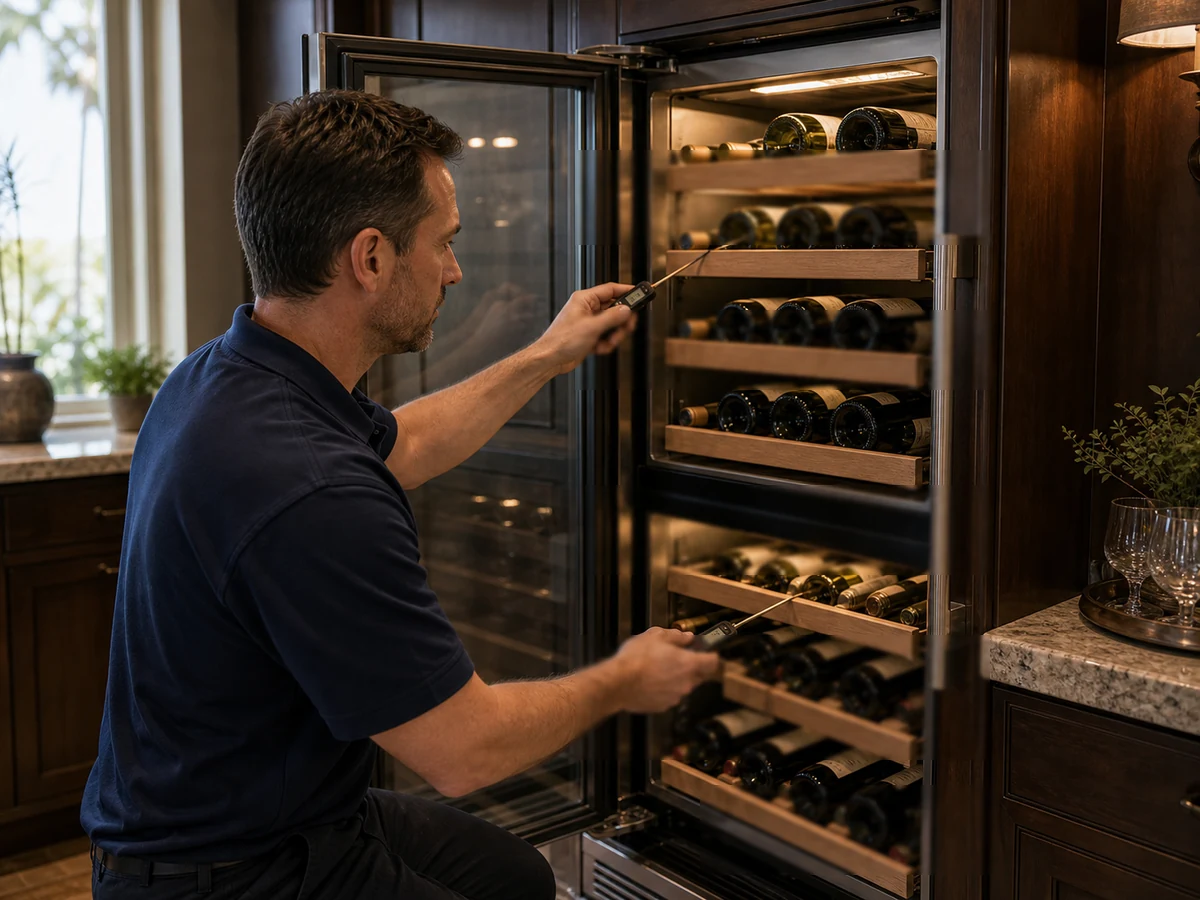
- Reference temperatures Calibrated thermometers go in at bottle height in each zone, read against the set points and the front display to expose a lying sensor.
- Airflow and evaporator The condenser is checked for salt and dust, the evaporator inspected for icing that points past a sensor to moisture or refrigerant.
- Seal and condensate path The door gasket and the drain that carries condensate away are both verified — the usual source of moisture pooling inside.
- Correction and stabilization The faulty component is renewed, and the cabinet is given time to settle back to its set points before the readings are confirmed.
What Each Temperature Reading Is Telling You
Long-term storage wants the mid-50s — 55°F is the conventional target, with a few legitimate degrees of spread between a dual-zone cabinet’s reds and whites. What the number is doing matters more than the number itself. This is how we read a cabinet’s behavior before opening it.
| What the cabinet is doing | Most likely cause | Urgency |
|---|---|---|
| Steady at 58–60°F, both zones | Condenser fouled, or set point nudged | Plan a visit; wine is safe meanwhile |
| One zone several degrees off the other | Drifted thermistor in the affected zone | Schedule soon; the zone is chasing a phantom |
| Swinging between low 50s and mid 60s | Failing sensor hunting; control fault | Prompt — swings age corks faster than steady warmth |
| Both zones warm and rising, unit running | Evaporator icing or refrigerant loss | Move irreplaceable bottles; call promptly |
Condensation: When It Is Physics and When It Is a Fault
Glass is the coldest visible surface in the room, and Ponte Vedra air carries water most of the year, so some sweating on a glass door in August is physics rather than failure — the same reason a cold window fogs. We do not chase that with a part. What earns a closer look is moisture inside the cabinet: fog between panes, droplets on the shelves, or water pooling at the floor of the unit. Those point to a tired door seal admitting humid air or a blocked condensate path that can no longer carry the moisture away.
The fix follows the evidence. A seal failing the dollar-bill test goes to the gasket line; a clogged condensate drain is cleared and re-routed so the cabinet can shed its own moisture again. A glass-door cabinet in an unconditioned butler’s pantry or near an outdoor bar will always work harder against humidity, which is why the coastal care calendar puts those placements on the tightest interval.
Owner Questions
Wine Storage Questions from the 32082 Cellar Set
Why do the two zones of my 424 read differently from their set points?
Each zone trusts its own thermistor, and thermistors age independently. A sensor that drifts reports a temperature the zone is not actually holding, so the cabinet chases a phantom number — one zone overcools while the other relaxes. We verify with reference thermometers placed at bottle height, then replace the sensor that lied.
Can a Sub-Zero wine cabinet survive in a garage or summer kitchen here?
It can, with honest expectations. A Florida garage swings hot and saturated, so the unit runs longer, condenses more moisture, and needs coil and drain attention on a shorter cycle than its kitchen twin. Outdoor and near-ocean placements add salt to the equation. We service these placements constantly — they simply need a closer watch.
What causes moisture inside a glass-door wine unit in Florida?
Glass is the coldest visible surface in the room, and our air carries water most of the year. Some exterior sweating in August is physics, not failure. Persistent fog between panes, pooling on shelves, or droplets inside the cabinet point at a tired door seal or a blocked condensate path — both correctable, both worth catching early.
Do you still service 400 series cabinets that are out of production?
Yes — the 424 and 427 families, built from 1999 into the mid-2010s, make up most of the wine storage in this ZIP and remain well supported with parts. Thermistors, fan motors, gaskets, and most control components are still obtainable, and the cabinets themselves were built to justify the investment.
What temperature should a Sub-Zero wine cabinet actually hold?
Long-term storage wants the mid-50s — 55°F is the conventional target — with a few degrees of legitimate spread between a dual-zone cabinet’s reds and whites. The danger is not a steady warm number so much as a drifting one; wine tolerates 58°F far better than it tolerates swinging between 52°F and 64°F as a failing thermistor hunts. We verify against reference thermometers at bottle height, not the front display.
My wine cabinet is louder than it used to be — is that a real problem?
New noise is worth a look before it becomes a failure. A rising hum or a rattle usually traces to fan bearings drying out or a compressor mount that has loosened with age, both contained repairs in the $250–$550 lane. In a butler’s pantry off a bedroom wing the noise is also a livability issue, so we catch it early — and a cabinet that has grown loud and warm together is signaling more than a bearing.
How long can my wine sit safely while a cabinet waits for repair?
It depends on which way the cabinet drifted. A unit holding a steady 60°F instead of 55°F is not an emergency — wine tolerates a slightly warm but stable temperature for weeks while parts arrive. The real risk is swinging: a failing thermistor that hunts between the low 50s and mid 60s stresses corks and accelerates aging, so a hunting cabinet deserves a faster call than a merely warm one. If a zone has gone genuinely warm, move the irreplaceable bottles to a cool, dark spot until the visit.
Does a flush-installed integrated wine column cost more to service than a 424?
Generally a little more, for access rather than parts. The IW and BW integrated columns sit fully flush in the cabinetry, so reaching the condenser, hinges or controls can require careful panel and hinge work that a freestanding 424 or 427 does not. The diagnostic discipline is identical — reference thermometers at bottle height, condenser and evaporator checked, condensate path verified — but we budget extra time on a flush column and confirm the model and serial before ordering any integration-specific part.
Arrange a Visit to Your Kitchen
Telephone hours run Monday through Saturday, 7:30 to 6:30. Same-week appointments across 32082, gate access arranged in advance.